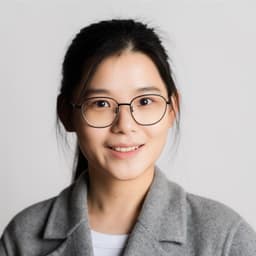
Hello, I'm
Yucheng Yang
Software Engineer / AI-ML EngineerVancouver, BC
About Me
I'm a Software Engineer and AI/ML enthusiast based in Vancouver, BC. I enjoy building scalable backend systems and applying machine learning to real-world problems.
My experience spans backend development with Java/Spring Boot and Python, as well as ML engineering with PyTorch and HuggingFace Transformers. I'm passionate about clean code, developer tooling, and shipping products that make a difference.
Outside of work, I enjoy building small games and dev tools as a hobby.
Skills
Languages
Backend
ML & Data
Tools
Projects
Mar. 2025 – Oct. 2025
Open-Source Community Toxicity Analysis
A large-scale NLP system that tracks how toxicity spreads across open-source communities over time.
Motivation
Open-source maintainers and researchers often sense that certain communities (e.g. gaming repos vs. ML repos) are more toxic than others, but there's little data-backed evidence of how toxicity evolves — especially around major external shocks like COVID-19. This project set out to quantify that.
What I built
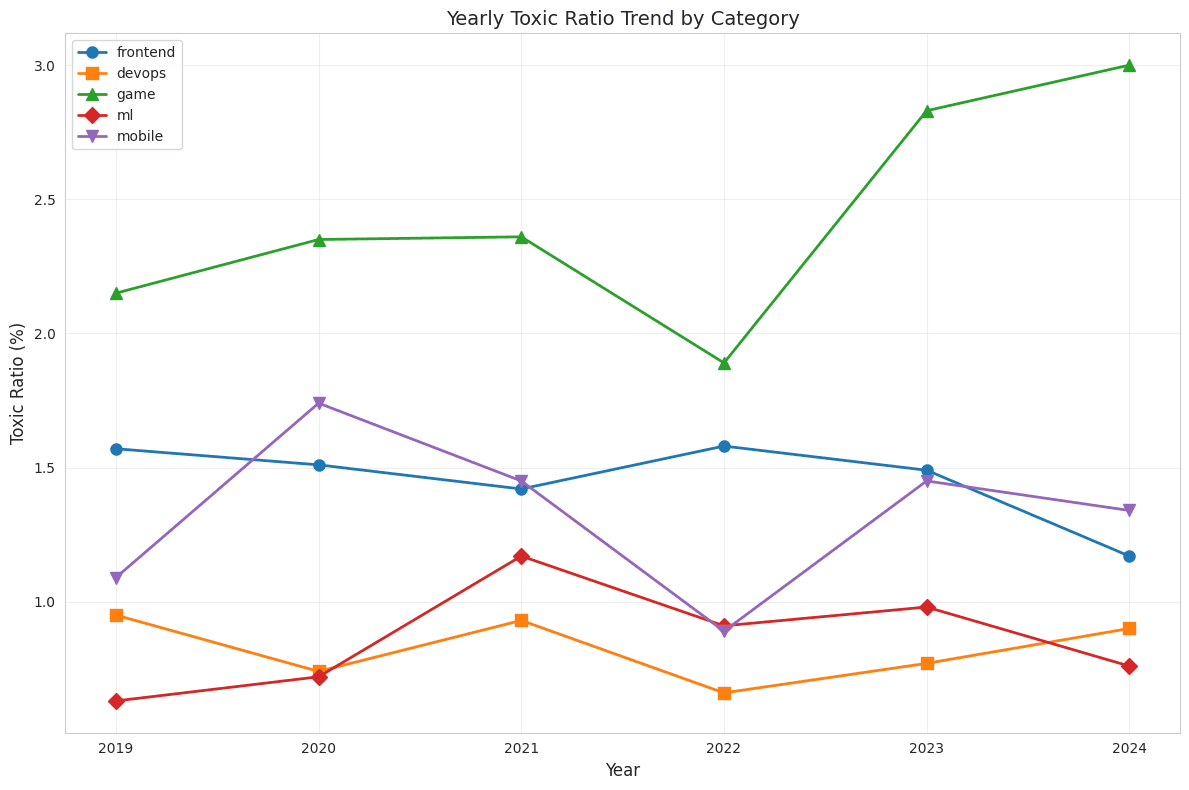
I built a data pipeline using DuckDB to process 2TB+ of raw GitHub Archive data down to a curated 300M-comment dataset, then fine-tuned transformer models (BERT, RoBERTa, DistilBERT) via Hugging Face to classify toxicity, tracking experiments with WandB. I then ran a 6-year time-series analysis across domains (ML, DevOps, Gaming, etc.) to see how toxicity shifted around key events.
Result
Domain-specific fine-tuning improved classification AUC-ROC from 0.76 to 0.93, and the time-series analysis surfaced clear toxicity spikes tied to real-world events like COVID-19 — showing that community tone is measurably reactive to the outside world.
Sep. 2024 – Feb. 2025
Autonomous Vehicle Behavior Clustering
An unsupervised pipeline that discovers behavior patterns between autonomous vehicles and motorcycles from real driving data.
Motivation
Motorcycles are one of the harder edge cases for AV planning — they're smaller, faster to maneuver, and behave less predictably than cars. Before you can teach an AV how to react to them, you need to understand what kinds of interactions actually happen. This project aimed to surface those patterns directly from data, rather than assuming them.
What I built
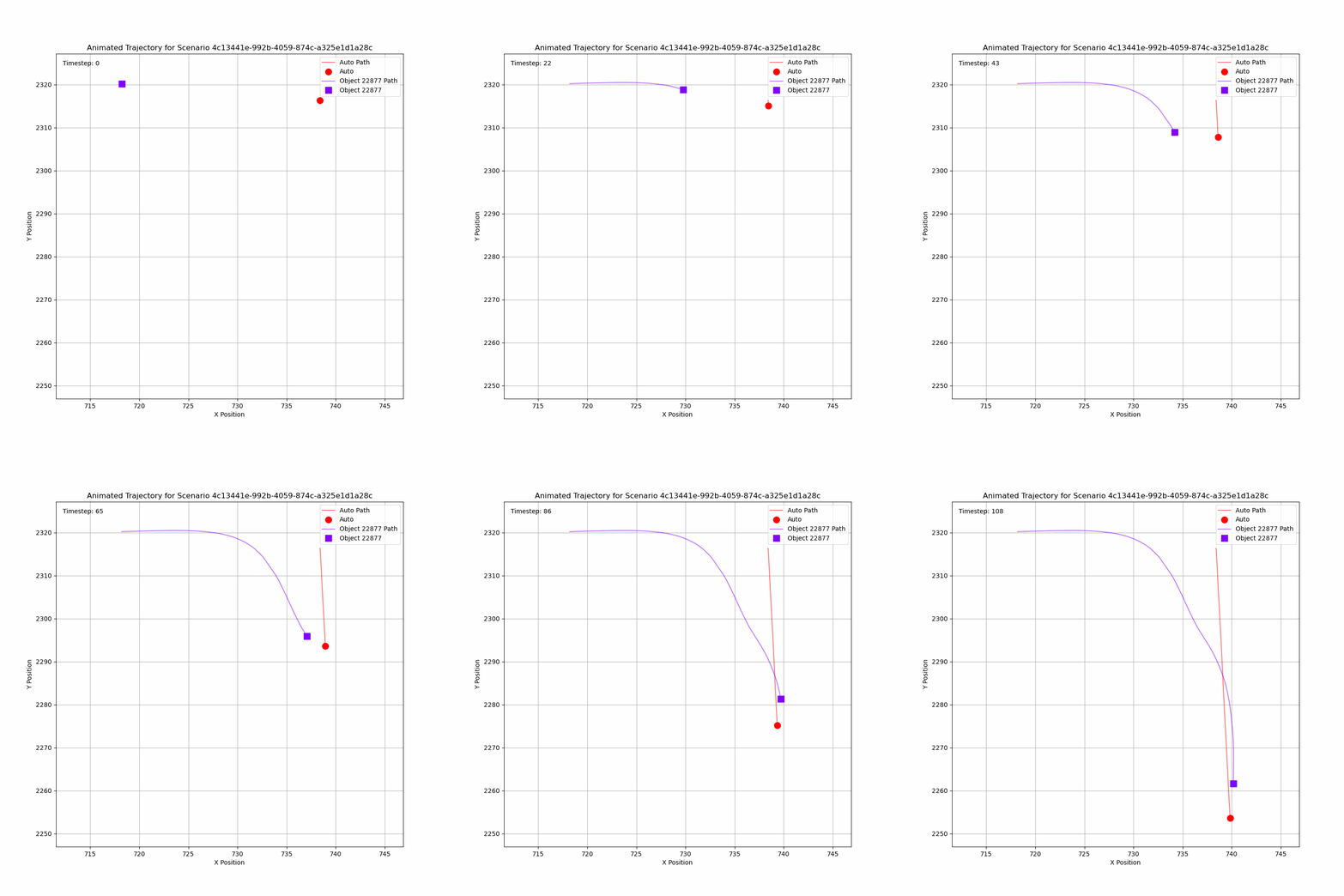
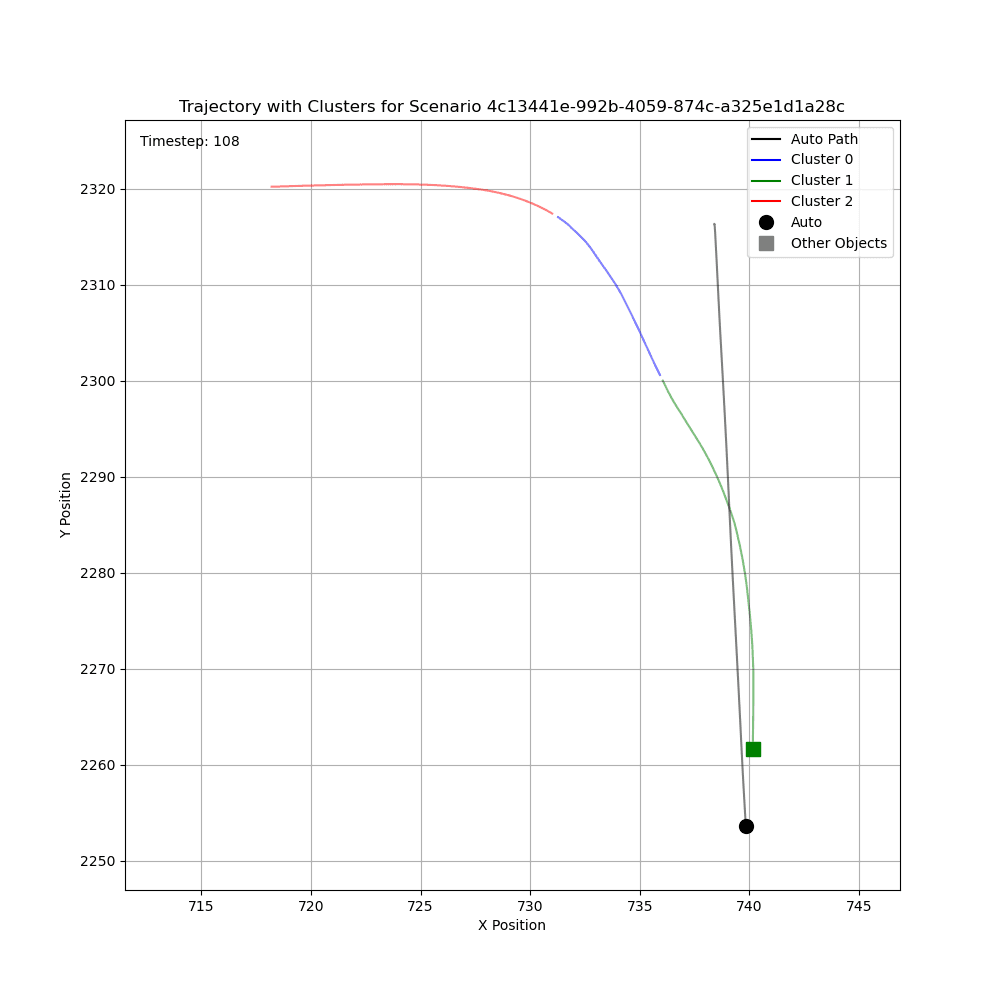
I mined 1,322 relevant scenarios out of a 250k-sequence Argoverse 2 dataset, then engineered spatial-temporal features (yaw rate, relative distance, velocity difference) to describe how vehicles and motorcycles moved relative to each other. I applied K-Means and DBSCAN on smoothed trajectories, using Silhouette Scores to validate cluster quality, and visualized the results as animated trajectory maps.
Result
The clustering revealed distinct, interpretable interaction patterns (e.g. overtaking, yielding, parallel travel) that could inform how AV planning systems anticipate motorcycle behavior.
Jul. 2019 – Oct. 2021
Quantum Key Issuance System
A production Java backend service that securely distributes quantum-generated random numbers to remote terminals.
Motivation
Quantum random number generators produce provably random data, but that data is only useful if it can be delivered securely and reliably to the systems that need it. This project built the software layer that made that possible in a production enterprise environment.
What I built
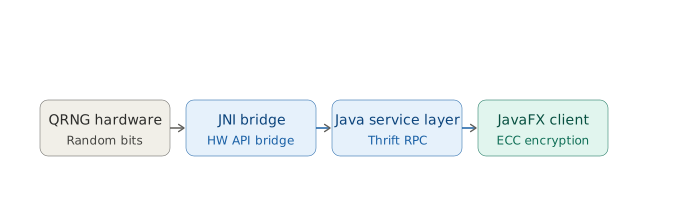
I developed a Java service layer to interface with the QRNG hardware, using Apache Thrift for low-latency RPC communication between the central server and remote issuance terminals. I bridged Java to the underlying C/C++ hardware APIs via JNI for device initialization and lifecycle management, and built a JavaFX desktop client with a custom ECC-based encryption scheme to protect data integrity during the issuance process.
Result
The system became the production key-issuance pipeline for the company's QRNG hardware line, and the ECC-based encryption approach was later co-patented.
Jul. 2018 – Mar. 2019
Quantum-Secured Office Network
Bringing quantum-generated encryption keys into everyday office infrastructure — VPN, VoIP, and video conferencing.
Motivation
Quantum encryption tends to stay in the lab or in highly specialized use cases. This project explored what it would take to bring it into ordinary enterprise workflows — the VPN employees use, the calls they make, the video meetings they join — without changing how people actually work.
What I built
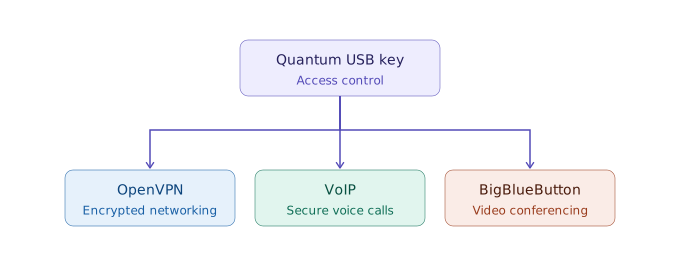
I integrated quantum-generated encryption keys into OpenVPN and VoIP architectures to provide hardware-level encrypted networking and voice communication. I also deployed and customized a self-hosted BigBlueButton video conferencing stack, tuning the Nginx reverse proxy configuration for low-latency media streaming, and built identity authentication modules for Android and web platforms that used quantum USB keys for unified access control across devices.
Result
The result was a unified, quantum-secured communication stack across VPN, voice, and video — with a single quantum USB key acting as the identity anchor across every terminal type.
Experience
Software Engineer
Jul 2018 – Oct 2021Reborn Quantum Technology Co., Ltd. · Hangzhou, China
- Built Java service layers integrated with C/C++ hardware APIs via JNI to support secure quantum key distribution systems, bridging the software and hardware sides of the product.
- Designed internal quality-testing tools to validate quantum random number generator (QRNG) output against national cryptographic standards, working closely with the hardware team.
- Co-invented patents on ECC-based encryption schemes used for secure key issuance.
- Authored technical documentation and led internal training sessions to help engineering and support teams ramp up on the system.
Education
Master of Science in Information Systems(GPA: 3.8/4.0)
Sep. 2024 – Dec. 2025Northeastern University, Vancouver, BC
Relevant Courses: Data Science, Web Development, Application Engineering
Bachelor’s Degree in Digital Media Technology
Sep. 2014 – Jun. 2018School of Software, Yunnan University, China
Relevant Courses: Data Structures, Networking, Database, Software Engineering